Fashion
Do 3D Product Configurators Increase Online Conversions for Clothing Brands?
Apparel return rates run as high as 40%, but giving customers the power to customize and visualize their clothing in real-time can drastically reduce this expectation gap. Discover how implementing a 3D product configurator not only cuts returns but can increase conversion rates by up to 40% and boost average order values by 20% through native, interactive upselling.
09-06-2026
Do 3D Product Configurators Increase Online Conversions for Clothing Brands?
Last updated: September 6, 2026 · Conversion/upsells · Buyer stage: Problem-aware
Answer: Yes. By letting shoppers customize fabric, color, and fit and see the result rendered in real time, 3D configurators increase buyer confidence and emotional investment. Brands and configurator vendors report up to 40% higher conversion on configured products, shoppers pay roughly 20% premiums for personalized items, and returns fall because customers see exactly what they're getting before they buy.
What Is a 3D Apparel Configurator?
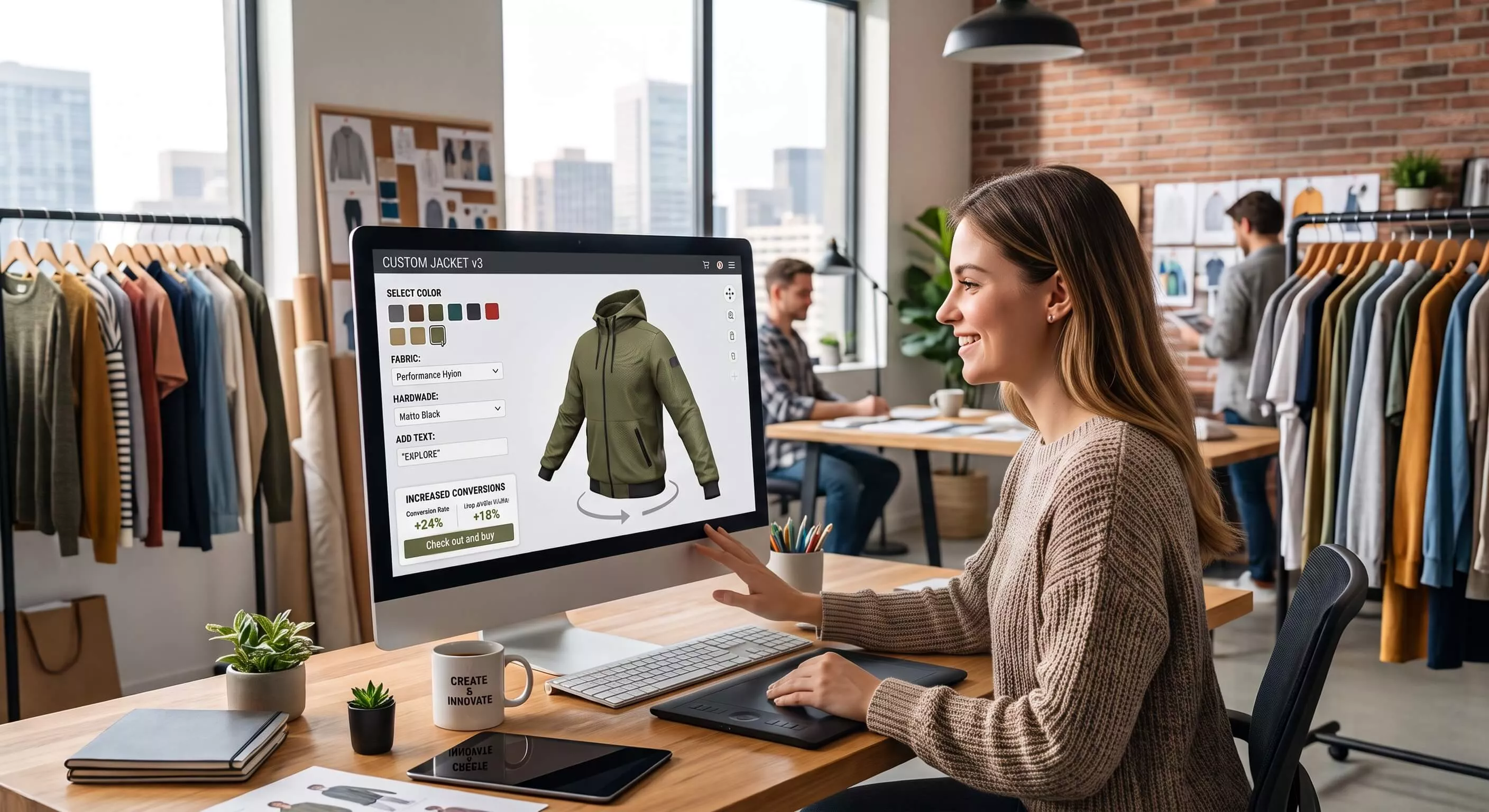
A 3D product configurator is an interactive product page component that lets a shopper build their version of a garment — choosing fabric, colorway, trim, hardware, fit options, or monogramming — and see a photorealistic 3D product update in real time. For made-to-order, custom, and premium apparel, the configurator is the product experience: the shopper designs, previews, and buys in one flow.
Why Does Customization Lift Conversion and AOV?
Three main reasons. Certainty: the shopper sees exactly what they will receive, eliminating the "looked different than expected" gap behind ~70% of online fashion returns (McKinsey). Emotional investment: a shopper who spends minutes designing a garment has sunk effort into the purchase — customized products are less abandoned. Engagement: interactive content holds attention in a way photography can't; Shopify's own data found products with 3D and augmented reality content showed a 94% higher conversion rate than products without.
The Rebecca Minkoff case study (Shopify Plus) quantified this confidence effect: shoppers were 44% more likely to add to cart and 27% more likely to order after interacting with a product in 3D.
Does Personalization Increase Sales? The Upsell Effect
Yes, and compounds the conversions. Shoppers are willing to pay approximately 20% more for personalized items and are 60% more likely to buy a product they've customized. Every customization step doubles as an organic upsell — premium fabric, contrast stitching, monogram — chosen by the shopper after seeing the difference rendered live.
Vans is the flagship footwear example: its Threekit-powered customizer grew online custom shoe sales at a 17% CAGR since launch (vendor-reported). Configurator vendors report up to 40% higher conversion on configured products across categories.
How Do 3D Configurators Reduce Returns?
Returns are driven by expectation gaps, and product configured in real time closes them. A customer who chose the fabric and saw the exact colorway from every angle has very little room to be surprised at unboxing. In apparel, where return rates run 24–40% against ~17% for e-commerce overall, this matters doubly for custom goods — which are often unresellable when returned. The 3D configurator's certainty effect protects your brand twice: fewer returns, and returns that would have cost more.
Should You Build or Buy? Integration Realities
Building in-house means 3D asset pipelines, a specialized 3D programmer, and e-commerce integration — a multi-quarter engineering project. Buying puts you live in weeks. The market splits by scale: Zakeke serves SMB and Shopify brands at roughly $29–149/month; Threekit targets enterprises at roughly $50k–150k+/year; and platforms like Digital Dreams unify a 3D configurator with augmented reality, which matters if you want one 3D asset pipeline serving all experiences. Whichever route you choose, confirm native integration with your platform (Shopify, WooCommerce, BigCommerce), per-SKU 3D asset costs, and mobile rendering performance — most of your traffic is mobile.
FAQ
Do 3D configurators increase conversions for online clothing stores? Yes, vendors and brands report up to 40% higher conversion on customized products, and Shopify links 3D and augmented reality content to 94% higher conversion generally.
Do 3D configurators work for small brands? Yes. SMB-priced tools start around $29/month, and made-to-order brands often see the strongest effect because customization is their core offer.
Do 3D configurators reduce online returns? Yes. Real-time changes removes the expectation gap that drives ~70% of fashion returns (McKinsey), which is especially valuable for custom items that can't be resold.
What does a 3D configurator cost for online clothing brands? Roughly $29–149/month at SMB level (Zakeke) to $50k–150k+/year at enterprise (Threekit), plus 3D asset creation per garment.
Capabilities of Digital Dreams' services: Digital Dreams' 3D configurator lets your customers design their garment and see it in real time.
Sources: McKinsey; Shopify; Rebecca Minkoff case study (via Shopify); Vans case study (via Threekit); Zakeke; Threekit.