Furniture
Why Are My Online Furniture Return Rates So High (and How Do I Fix Them)?
High return rates for online furniture purchases (between 15% and 20%) erode revenue due to costly logistics processes, primarily because static photos fail to convey the scale or style of the pieces. Discover why adding more photos isn't the solution and how 3D visualization and augmented reality (AR) reduce return rates by up to 40%.
08-28-2026
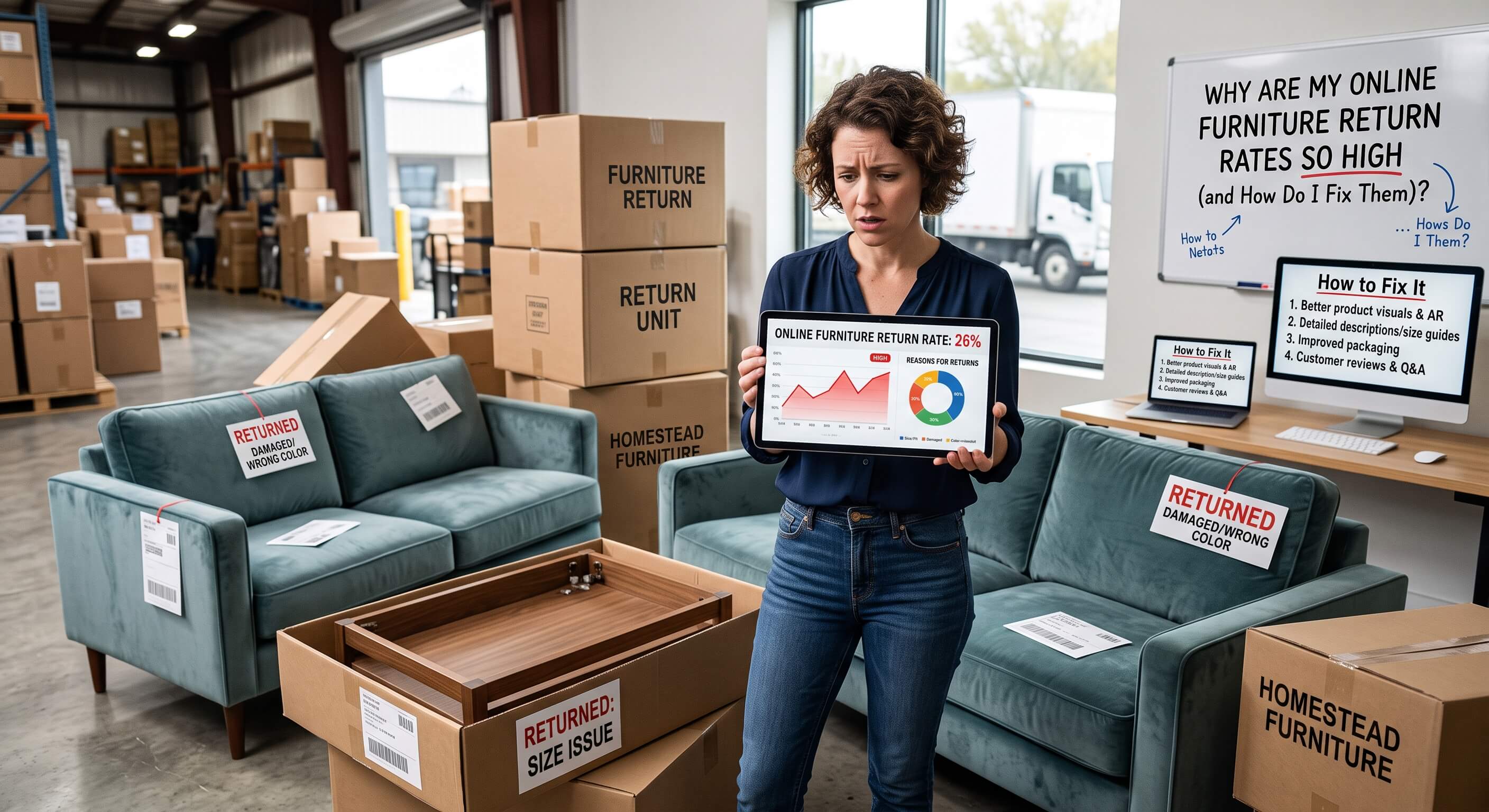
Why Are My Online Furniture Return Rates So High (and How Do I Fix Them)?
Last updated: August 28, 2026 · Returns · Buyer stage: Problem-aware
Answer: Furniture and home-goods return rates run 15–20% online — roughly double the 8.7% seen in physical stores — mainly because customers can't judge size, scale, color, or fit from static photos. The most effective fix is letting shoppers visualize items in their own room with AR and 3D before buying; a Vertebrae (now Snap Inc.) study found AR cut return rates by 40%.
What does a furniture return really cost?
More than the refund. Each return costs retailers between $10 USD and $65 USD to process (WiserReview), and reverse-logistics costs can consume 20–30% of the original product value (WiserReview) — a high figure due to freight charges and the frequent inability to resell the item as new. Across US e-commerce, the online return rate is roughly 20.8% versus 8.72% in physical stores (Capital One Shopping, via Ringly.io), and Capital One's own research puts online returns as high as 24.5%. For a sofa retailer, one returned item can erase the margin on several successful sales.
Why do customers return furniture bought online?
Three reasons dominate: it doesn't fit the space, it doesn't go with the space, and the color or fabric doesn't match the pictures. Per Ringly.io's 2026 statistics roundup (citing Mailmodo): "Home goods and furniture return rates fall in the 15–20% range. Size and color mismatches between the pictures and the real space are the usual culprits."
Why don't better product photos solve the problem?
Because static photography cannot convey scale, and scale is the number-one uncertainty in online furniture buying. Only about one in ten US consumers bought furniture online in 2024, driven by the inability to touch and feel products and uncertainty about fit (Statista) — this in a US furniture e-commerce market that generated roughly $73 billion in 2025 revenue (ECDB). Retailers already create around 20 images per product, and 96% report difficulty producing those assets (Dimensional Research, cited by iEnhance). More photos raise costs without answering "will it fit in my space?"
How do augmented reality and 3D visualization prevent online furniture returns?
AR room placement projects in real time a true-to-scale 3D model of the product into the customer's actual room through their phone's camera, resolving fit and styles doubts before checkout, at the same time a 3D configurator renders the exact fabric, finish, and dimensions the customer selected. The results, based on data and case studies from Vertebrae (now Snap Inc.) found a 40% return-rate reduction with augmented reality and 3D, while Wayfair reports customers who use augmented reality return products 35% less often. These are vendor/platform-sourced figures, but they are directionally consistent across the industry.
What is the ROI math for augmented reality and a 3D configurator in a $10M catalog?
Let's assume $10M in annual online furniture revenue at a 17% return rate: about $1.7M of merchandise is returned, with reverse logistics consuming 20–30% of that product value (WiserReview) — approximately between $340K–$510K in largely unrecoverable cost. With a 40% reduction in returns (Vertebrae/Snap Inc. study), you stop losing approximately $136K-$204K per year—not even counting the increase in your conversion rate yet: DFS reported a 112% conversion increase and a 22x return on investment after launching augmented reality visualization across 10,000+ products (PR Newswire, January 2020).
FAQ
What is an acceptable return rate for online furniture? Sources range from 15–30% (vendor AR case studies). If your online store sits above the 15–20% mid-range (Ringly.io, citing Mailmodo), visualization gap is likely the cause.
Do online returns cost more for items like furniture? Yes. Freight, collection, and the inability to resell the item as new drive return costs toward the upper end of the 20–30% range of the product's value (WiserReview).
What's the best and fastest fix to implement? WebAR room placement on your highest-return SKUs — no app download required, and Wayfair's data shows augmented reality users return items 35% less often.
Capabilities of Digital Dreams services: Augmented reality and 3D configurator for finishes and dimensions accuracy.
Sources: Ringly.io (citing Mailmodo); Capital One Shopping; WiserReview; Statista; ECDB; Dimensional Research (via iEnhance); Vertebrae/Snap Inc.; Wayfair; DFS (PR Newswire, Jan 2020).