Art
Why Are My Wall Art Return Rates So High (and How to Fix It)?
High online wall art returns (8–15%) quickly erode your margins, largely because shoppers struggle to judge true size and color from a phone screen. Discover why lifestyle photos aren't enough to build buyer confidence, and how augmented reality and 3D visualization can cut return rates by up to 42% by letting customers preview art directly on their own walls.
08-01-2026
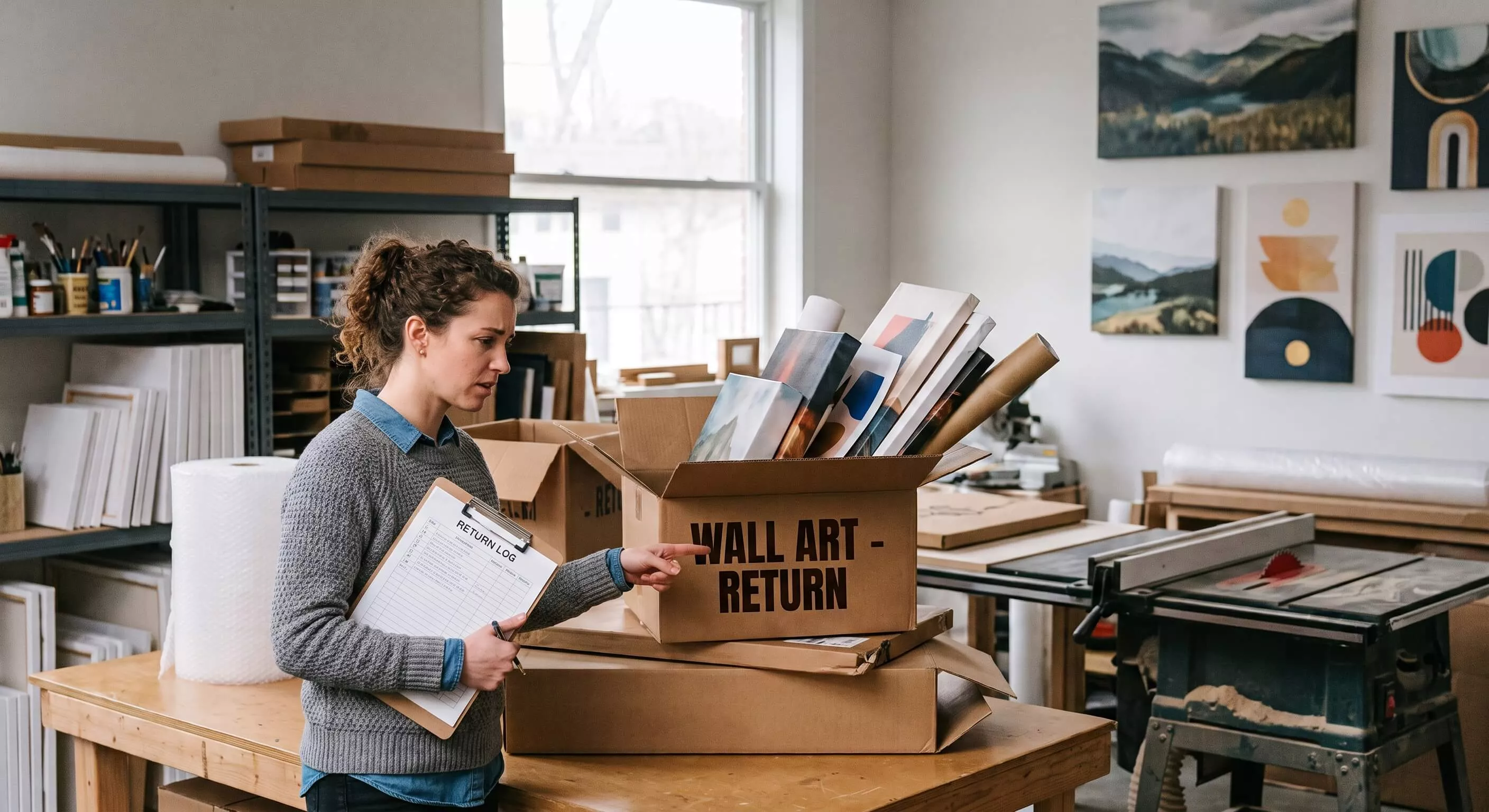
Why Are My Wall Art Return Rates So High (and How to Fix It)?
Last updated: August 1, 2026 · Returns · Buyer stage: Problem-aware
Answer: Wall art return rates run 8–15% online (IndexBox), well above general retail, and two causes dominate: customers misjudge the size on a screen and the colors look different in their room. 3D previews and in-room augmented reality visualization address both doubts, with art-specific data showing up to 42% fewer returns.
What are the real reasons why wall art purchased online gets returned?
Return data for the category is remarkably consistent. Size misjudgment is the #1 return reason for wall art, and color discrepancy is #2 (MyPhotoStation), with shipping damage a distant third. IndexBox's US Framed Wall Art Set report puts e-commerce return rates for the category at 8–15% — a heavy burden for a product that converts at only ~1.4% online to begin with (Firework, 2026).
Both top causes are perception problems, not product problems. A 24"×36" canvas looks identical to an 18"×24" canvas on a phone screen. A warm-toned print photographed in studio lighting reads differently against a cool gray wall. The customer isn't wrong to return it — the product page simply never let them verify scale or color on their actual space.
What does a wall art return actually cost you?
Framed and canvas pieces are bulky, fragile, and often made to order. A single return typically means paying outbound and return shipping on an oversized parcel, inspection and repackaging labor, and — for custom-framed or print-on-demand pieces — a write-off, because the item, in most cases, cannot be resold. On top of the hard costs, every return erodes the margin you spent on ad dollars to win, not to mention the cart abandonment in home décor already runs between 83.7% and 88.6% (Convertcart), so the buyers who do complete checkout are expensive to acquire and painful to refund.
Why don't better product photos solve it?
Photos answer "what does it look like?" but not "what will it look like on my wall?." The photos on a website show the art in someone else's room, at an ambiguous scale, under studio lighting. Saatchi Art's General Manager Jeanne Anderson put the gap plainly: "80% of hesitant art buyers report they want to see art and imagine it in their space before they make a purchase." No amount of static photography closes that gap — it's inherent to the online business.
How does in-room visualization fix size and color doubt?
Augmented reality (AR) wall placement lets the shopper point their phone at their own wall and see the exact piece, true to scale, in their own lighting — before buying. A 3D configurator adds the second layer: previewing frame, mat, finish, and dimension combinations in real time, so "wrong frame" and "wrong size" errors are caught at the decision stage instead of the doorstep.
The impact data is strong, although much of it is vendor-reported: Banuba (2024) finds augmented reality experiences reduce return rates by 22% to 40%, and that 66% of AR users say they are less likely to return an item. Wayfair's "View in Room" feature specifically cut returns by 43% (Zolak, 2026). For art specifically, Pictureit (citing eMarketer/ARtillery) reports 42% fewer returns and 27% higher average order value when customers first customize and then visualize the art in their space first. Digital Dreams builds both capabilities — WebAR in-room placement and a 3D frame/size configurator — directly into your product pages, no app download required.
A returns-reduction checklist for wall art stores
Work through these steps in order of impact. Add true-to-scale augmented reality preview to every product page, so size doubt is resolved before checkout. Add a 3D frame and size configurator so that your customers confirm the exact variant they're ordering. Publish printed dimensions in both inches and centimeters next to a human-scale reference. Calibrate product photography and note that screen colors vary. Show room mockups at multiple wall sizes for shoppers who won't use augmented reality. Track return reasons at SKU level and watch the size and color share fall.
FAQ
What is a normal return rate for wall art sold online? E-commerce return rates for wall art run between 8% and 15% (IndexBox, US Framed Wall Art Set report), higher than typical general-merchandise rates.
What is the #1 reason customers return wall art? Size misjudgment — the piece is larger or smaller than expected — followed by color discrepancy (MyPhotoStation).
Does augmented reality really reduce returns? Attributed industry data says yes: 22–40% reductions (Banuba, 2024), a 43% cut at Wayfair (Zolak, 2026), and 42% fewer returns for art specifically (Pictureit, citing eMarketer/ARtillery). Run your own pilot to confirm on your catalog.
Can I add augmented reality without building 3D models of every piece? Yes. You can start only with your highest-return SKUs — Digital Dreams generates the true-to-scale augmented reality models of your products.
Capabilities of Digital Dreams services: Augmented reality and 3D configurator for finishes and dimensions accuracy.
Sources: IndexBox; MyPhotoStation; Firework, 2026; Convertcart; Banuba, 2024; Zolak, 2026; Pictureit (citing eMarketer/ARtillery).